

مدونة
Retort Pouch vs Canned Soup: Which Pack Format Actually Holds a Longer Shelf Life?

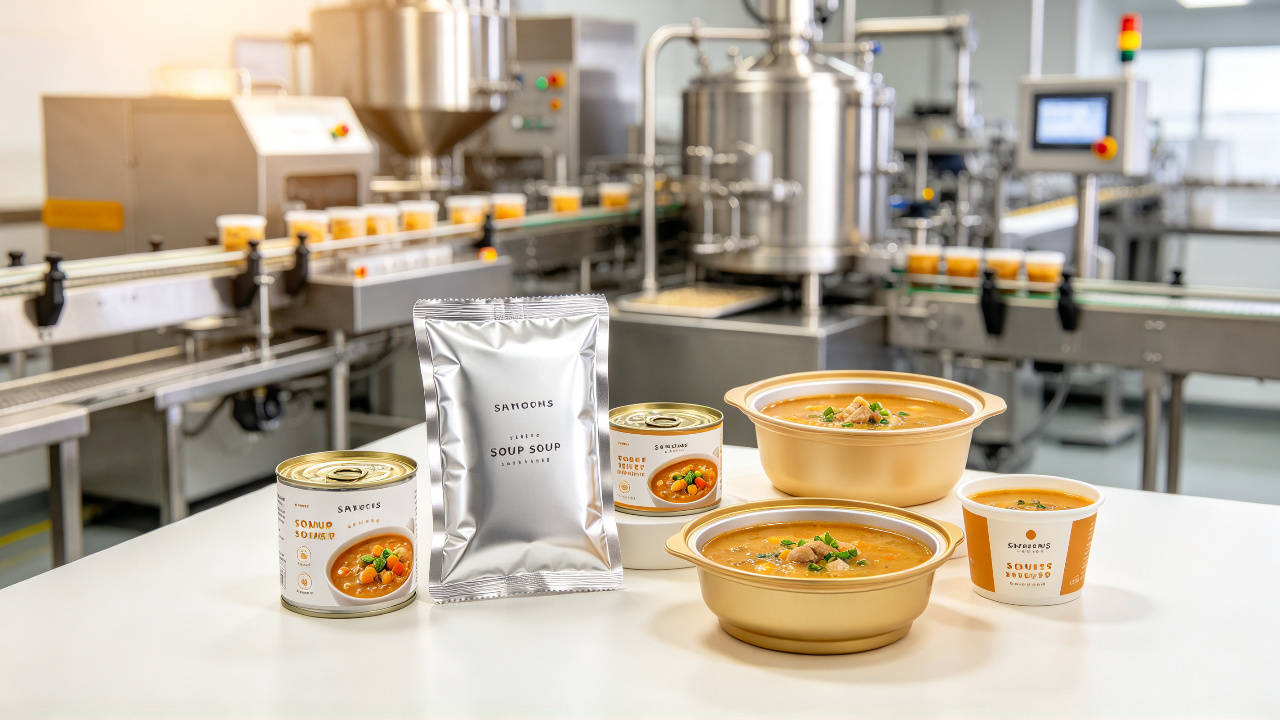
Retort Pouch vs Canned Soup: Which Pack Format Actually Holds a Longer Shelf Life?
The first question in the brief was not about cost. An importer already carrying canned soup wanted to add a pouch line and asked, before anything else, whether the new pack would hold its shelf life long enough to sit in the same warehouse as the cans. That question shaped the project. Retort pouch vs canned soup is not really a contest between two containers. It is a contest between two ways of keeping oxygen, moisture, and microorganisms out, and everything else — format, seal, test protocol — follows from that.
Three Requirements and a Formulation That Came With Them
The brief ran to three pages and held three fixed points. Shelf life parity with the line the buyer already sells. A label that clears the destination market without being reprinted. A pack that survives the shipment without a second carton around every unit.
The formulation came with it. That put the project in OEM territory by definition: the recipe was the buyer’s, and the work was to reproduce it in a different container without changing what it tastes like.
Soup packaging for importers carries one constraint a domestic buyer never feels: the pack has to hold through a longer and rougher journey before anyone opens it. And a soup retorted in a can and the same soup retorted in a pouch are not the same process. The container sets the retort cycle, the cycle sets the heat load, and the heat load changes texture, color, and how the solids hold. The first job was not picking a bag. It was finding out how much of the recipe survived the move.
Retort Pouch vs Canned Soup: The Barrier Is Not the Dividing Line
The intuitive answer — the can wins — does not survive a look at the structure. A metal can is an absolute barrier: no oxygen, no moisture, no light, and exactly one engineered weak point, the double seam.
A retort pouch barrier layer does the same job with three films bonded into one. An outer polyester carries the print and takes abrasion. A foil core stops oxygen, moisture, and light. An inner cast polypropylene faces the food and becomes the seal under heat and pressure. With a foil core, transmission comes close enough to a can that the difference stops mattering for soup.
What separates the formats is mechanical. Cans are rigid; pouches flex, in the retort, in the case, in a shopper’s hand. Flexing fatigues the foil, and a crease running through the core opens a pinhole. A pouch specification is therefore not “foil laminate” but foil thickness, layer count, and the drop and stack tests that go with them.
Commercially, canned soup shelf life is usually quoted at two to five years, and the pouch’s reputation for being shorter comes from thin laminates rather than from the format itself. On the soup formats we produce, accelerated testing supports 24 months.
A foil laminate fails at the fold, not in the middle of the panel. Repeated flexing opens pinholes that a vacuum test on a flat sample will never show.
Pouch, Bowl, or Cup: Geometry Sets the Retort Cycle
Soup packaging formats come down to three shapes, and each shape creates its own retort problem.
Pouch. A flat profile puts the cold point close to the wall, so heat reaches the slowest part of the fill quickly. That gives the shortest cycle and the least heat damage to texture and color. The trade-off is support — a pouch needs a gusset or a holder to stand — and the folded corners, where four layers of laminate meet, are the first place a leak appears.
Bowl. Rigid walls and a wide diameter move the cold point toward the center, and it travels during rotation. The lid has to be held down against the pressure built inside the pack during the cycle, so bowls are usually retorted under air overpressure. Without it the lid domes and the seal peels back from the rim.
Cup. Shallow, with a foil lid sealed to a rim. Rim width and rim flatness do as much for seal integrity as the sealing parameters do. A rim with an uncontrolled mold line will leak at exactly the temperature the seal was set for.
Self-heating bowl. This one adds a component the others do not have: the base. The consumer rotates the bottom of the container to activate the heater — no flame, no power, and no water added from outside. For the packaging specification that means one more joint to qualify, and it faces the same retort cycle, the same drop test, and the same stack load as the food compartment.
The format range is not theoretical; it is what the sampling plan has to cover, and it changes product by product. A ginseng soup packed as an instant ready meal and a bowl soup do not share a retort profile.
What the Seal Bars Are Actually Controlling
Three parameters sit on the seal bar, and each one fails in a different way.
Temperature melts the inner seal layer so two faces fuse into one. Too low and the fusion is partial — a channel that holds at atmospheric pressure and opens in the retort. Too high and the seal layer squeezes out of the joint, leaving a thin edge that peels weeks later.
Pressure collapses the gap between the faces and drives air out of the joint. Dwell gives heat time to reach the interface. A short dwell with a hot bar passes a peel test taken straight off the line and fails a three-week stack test, because the seal was never fully formed through its thickness.
Headspace belongs in the same conversation. A pouch needs enough of it for the fill to expand and for steam to build the internal pressure that balances the retort. Too little, and the seal carries that load instead.
A single product strand across the seal bar creates a channel that survives the retort and passes a visual check. Fill accuracy is a sealing parameter.
Four Ways to Try to Break a Seal
A seal that looks continuous is not a seal, and the checks that count are mostly destructive.
- Water-bath vacuum. The pack goes under water in a chamber and vacuum is drawn, so the pressure inside the pack becomes relatively higher than the chamber. Air leaves through any pinhole as a steady stream of bubbles. When the vacuum releases, water is pushed back into the channel and shows on opening.
- Dye penetration. Seal edges are exposed to a dye solution that travels along a channel pressure alone did not find.
- Burst test. The pack is inflated until it fails. The number is a margin, not a pass mark, which is why it says more than a visual inspection.
- Peel strength. A sealed strip is pulled apart and the force per unit width recorded at the start, middle, and end of a run. Bar temperature drifts across a shift, and the ends of the run tell you before the middle does.
Timing matters as much as method. The meaningful leak test runs after the retort, because the retort is the stress event: the laminate stretches, the seal creeps, and the headspace pressure spikes. Testing only before the cycle measures a seal that has not yet been asked to do its job.
What Shelf Life Testing Can and Cannot Prove
The shelf life testing methods used on a retorted soup are two, and they answer different questions.
Accelerated testing holds packs at elevated temperature and pulls them on a schedule. Each pull is assessed on sensory attributes — color, texture, separation, aroma — on agreed physico-chemical indices, on microbiology where the product and the stage require it, and on pack integrity. The time to reach the failure threshold is projected back to ambient storage. On our soups this supports 24 months.
Real-time testing runs alongside and projects nothing. It records what happens to packs stored the way they will actually be stored, which is the figure a retailer eventually asks for.
Accelerated testing has a blind spot worth naming: heat speeds up chemistry, not mechanics. Oxidation, color drift, and starch change all arrive early under heat. Flex pinholes, seal creep under stack load, and abrasion in transit do not, because they depend on handling rather than on temperature. Those need drop, vibration, and stack tests, and they need a retained pack to compare against later.
A can and a pouch also fail in different places, so the protocol differs at the edges. On a can the watch items are the double seam and internal corrosion. On a pouch they are the seal and the laminate.
Elevated temperature speeds up chemistry but not mechanics. Pinholes from handling and seal creep from stacking only turn up in transit and stack tests.
Where the Sampling Sequence Stalls
The sequence does not change with the product or the buyer: private label soup packaging for importers goes through the same eight steps as a single-market launch, and the ginseng soup packed as an instant ready meal goes through them alongside a bowl soup.
Step five is sample testing: sensory, physico-chemical, microbiology where required, and a preliminary seal check on the pack itself. Step six is customer approval — samples go out, the buyer tastes, comments come back, and a re-sample follows if needed. That step is where schedules most often stall, and rarely because the sample is wrong. It stalls because feedback arrives in three batches from three people. Fixing the tasting panel and the single sign-off before the first sample ships costs one meeting.
Step seven is packaging and labeling confirmation: packaging material, label and product information, sample numbering, and batch records. For a custom printed retort pouch OEM soup project, artwork locks here, and it locks earlier than most buyers plan for. The print sits on the outer film beneath retort-resistant ink and adhesive, and once the roll is printed it cannot be edited. Surface inks that look correct on a proof can blush or lift through the cycle, so ink and adhesive are selected for the retort, not for the artwork file.
Step eight is final sample dispatch: final check, photographs, retained samples, registration, and a courier with tracking. The retained pack is not paperwork. It is what the shelf life packs get compared against a year and a half later.
The Answer That Went Back
The recommendation was not a single format.
On the question of which soup packaging has longer shelf life, the format name does not decide it. A foil-based pouch with a qualified seal matches a can on barrier performance, and the can’s real advantage is that it does not crease. So: pouch for the new line, where storage is controlled and the case is specified by the retailer; can for the volume line and for routes where the shipment is rough; cup for single-serve with a fast shelf turn; self-heating bowl where the heat is part of what is being sold and the pack is the product.
That is what a format decision looks like once it is written down — a seal strength curve, vacuum-tested packs pulled from three points in a run, and a 24-month projection backed by accelerated data. The shape of the container settles very little on its own.
Frequently Asked Questions About Self-Heating Soup
How long does canned soup last unopened?
Commercially packed canned soup is usually dated between two and five years from production, unopened and undamaged. The limit is set by the double seam and by internal corrosion on acidic fills, not by the food itself. Once a can is opened, it becomes a refrigerated product with a short window.
Do retort pouches actually last as long as cans?
With a foil core and a qualified seal, the barrier performance is comparable. The failure modes differ, so the testing differs. A pouch is more sensitive to flexing and to seal-zone contamination. A can is more sensitive to the double seam and to corrosion from the inside.
What does a retort pouch shelf life testing protocol include?
Accelerated packs pulled on a schedule for sensory, physico-chemical, microbiological, and pack integrity checks; real-time packs stored as they would be in trade; and mechanical tests that heat cannot substitute for — drop, vibration, stack, and seal strength at several points in the run.
What are the ODM soup packaging format options if we start from your range?
In an ODM project the starting formulation is one of ours; the buyer selects it, then changes the recipe and the pack to fit the market. The format set is pouch, bowl, cup, and self-heating bowl. Which one is viable depends on the fill, the size of the solids, and the shelf life target, and it is settled at sampling rather than at the first call.
Two containers, one question, and an answer that came down to a seal rather than a shape. The importer left with a pack it could defend to a retailer and a test record behind every claim in the specification. That is the useful outcome of a format comparison — not a winner, but a failure mode you know how to test for.
Develop Your Own Self-Heating Soup Product
بدءًا من تطوير الوصفات ومعالجة التعقيم الحراري وصولاً إلى التعبئة والتغليف والوثائق الجاهزة للتصدير، تدعم ZeaGrove تطوير منتجك بمعلومات العملية التي يمكنك التحقق منها مقابل مواصفاتك الخاصة.
 English
 Chinese
 French
 Italian
 Russian
 Arabic
 Indonesian
 Vietnamese
 Thai
 Spanish