

Blog
How Soup in Pouches Is Made: Hot Fill and Retort Sterilization Step by Step

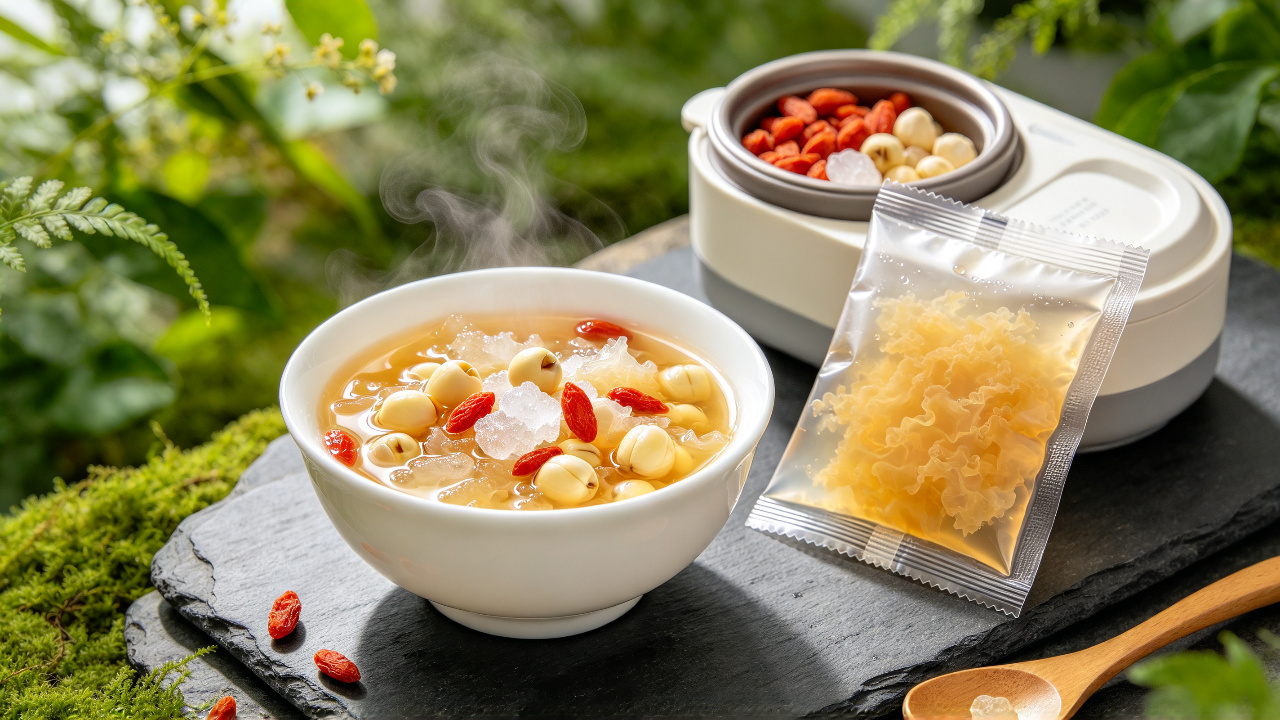
How Soup in Pouches Is Made: Hot Fill and Retort Sterilization Step by Step
A brand owner came to the plant with a sweet soup, a shipping target, and three requirements: it had to hold at ambient for the retail calendar, the pack had to heat itself with no water and no power, and the formula had to stay theirs. The first two are solved on the line. The third decided the working relationship. There was a recipe in hand, so the job was OEM soup pouch production — produce to a customer formula — rather than ODM, where a brand picks a base from the factory's existing range and adjusts it. One decision governed everything after it: hot fill vs retort.
What the Brief Actually Asked For
The brief listed a shelf-stable sweet soup, a self-heating container, and the brand’s own formula. Two of those are packaging and process questions. The third is a scope question, and it changes who owns what.
The self-heating requirement fixed the container before the recipe was settled. The pouch drops into a container whose base carries the heating module; the person eating rotates the bottom of the container to activate it, and the pack warms without a stove, a plug, or added water. That rules out a pouch meant to be emptied into a pot, and it rules out any format that needs the eater to add something.
What remained was the real work: get the soup into a pouch, seal it, and make the whole pack stable at ambient for the length of the retail calendar. That is where the soup pouch manufacturing process starts, and the sequence that follows is the one private label soup production runs through every time.
Intake Sets the Solids Before Anything Else Does
Dried tremella, lotus seeds, goji, rock sugar, and fresh pear arrive as agricultural lots, not as ingredients with fixed behavior. Two deliveries of the same grade can rehydrate to different weights, hold different amounts of water, and soften at different rates under heat.
Intake exists to turn that variability into a number. A specification is agreed at sampling — rehydration yield, piece size after soaking, defect limits, moisture — and every lot is checked against it before it goes to the kettle. Anything outside the range is held rather than blended into the next lot to average it out.
The reason is not fussiness. Solids size and water uptake decide how heat moves through a filled pouch later, so a shift at intake quietly changes the process that was validated for the previous lot. A soup can look and taste correct on the bench and no longer match its own sterilization record.
Turning a Kitchen Recipe into a Formula That Survives Heat
A recipe written for a home pot assumes the cook will adjust as it goes. A formula for a sealed pouch cannot. Batching fixes sugar, acid, starch, and the solids-to-liquid ratio so the same pot is reproduced on every run.
Two numbers matter more than the flavor balance at this stage. pH decides which sterilization path is available at all, because the boundary between an acid product and a low-acid one changes the required process. Viscosity decides how fast heat reaches the center of the pouch. Thicken a soup and it stops convecting; heat has to conduct through the mass instead, which is slower.
Starch choice is the usual failure point. A native starch that thickens beautifully on the bench can break down through retort and leave a thin soup with solids settled at the bottom of the pouch. A starch that holds too well can leave a product that is hard to move through the fill line and slow to heat. In OEM soup pouch production the batch sheet belongs to the customer’s formula, so any change to it comes back through the same approval.
Thickening a soup slows convection and shifts where the coldest point sits during sterilization, so a late texture change reopens the process validation.
Hot Fill vs Retort: Where the Process Splits
Two routes cover most of this category, and they are not interchangeable.
Hot fill soup pouches are filled at a high temperature, sealed, held briefly, then inverted and cooled. The heat already in the product does the work, and the process leans on acidity to make that sufficient. It suits fruit-forward, high-acid products and keeps a clean, fresh profile.
Retort pouch soup processing goes the other way: the pouch is sealed cold or warm, and then the whole pack goes into a pressurized vessel where it is heated above the boiling point of water. Overpressure is what keeps the pouch from inflating and stressing its seal. Low-acid soups — anything above the acid boundary at pH 4.6 — need this path, because heat at atmospheric pressure will not deliver a commercially sterile pack.
The choice is not about which is better. Put a low-acid soup through a hot fill and the risk surfaces weeks later as swelling. Over-process a delicate solid through retort and the texture is gone.
Filling: Weight, Headspace, and a Clean Seal Zone
Every pouch has to leave the filler with the same net weight and, more importantly, the same headspace. Headspace is the gap left between the soup surface and the seal area, set by fill volume and by how the pouch is presented to the sealer.
Too little headspace and the pouch has nowhere to expand when it is heated under pressure; it balloons and pulls at the seal. Too much and the pack reads short on shelf while the fill weight drifts. For hot fill, the fill temperature is a process parameter rather than a convenience — it is part of the preservation step and is recorded as such.
The common defect is quieter: product on the inside of the seal area. A strand of tremella or a film of sugar syrup across the seal zone creates a channel that holds at first and leaks later. Nozzle position, fill speed, and a flat, clean sealing zone matter more than the sealer’s headline rating.
Sterilization: Getting Heat to the Coldest Point
Of the pouch sterilization methods in use, retort is the one that must be validated pack by pack. A run is defined by three things at once: temperature, time, and pressure. Temperature and time deliver the lethality; pressure holds the pouch’s shape while the contents expand.
The number that drives the schedule is the cold spot — the point inside the pouch that heats last. It is not always the geometric center. In a soup with large solids, the slowest point sits wherever convection is blocked by packed pieces, which is why piece size is fixed at sampling and why a change in cut size is treated as a process change rather than a recipe tweak.
Load pattern matters as much as the product. Pouches laid flat in a crate heat differently from pouches standing on edge, and a crate loaded more densely than the validated pattern lengthens heat-up for the entire batch. That is the kind of drift no bench sample will show you.
A larger solid blocks convection near the cold spot, so changing the cut size in a recipe reopens sterilization validation rather than only altering texture.
Cooling Under Pressure, Not After It
Cooling is the step most often treated as a formality, and it is where good batches are lost. The pressure inside a hot pouch stays above vessel pressure until the contents cool, so overpressure has to be held all the way down.
Release the pressure early and the pouch inflates, the seal stretches, and a pack that passed every check at the filler is now a leaker. Cool too slowly and the product sits in the range where texture and color keep cooking. Cool with water of poor microbiological quality and a pinhole that would have been harmless becomes an entry point.
Cooling water quality is part of the process for that reason, and so is the temperature the pouch reaches before it leaves the vessel. Both are recorded, because both belong to the batch record across the whole shelf life rather than to a single day.
Seal and Leak Testing After the Retort
Seal integrity is set at the sealer — temperature, pressure, and dwell, all three fixed at sampling — and then verified after the retort, because the retort is where a marginal seal is most likely to give way.
Verification runs in layers. A visual check looks for wrinkles, folds, and product trapped in the seal. A squeeze test finds the obvious channel. A water-bath vacuum test submerges the pouch, pulls a vacuum, and watches for bubbles or water drawn inward; it catches pinholes a squeeze cannot, including the ones made at pouch corners during handling.
A leak that passes today is not a pass. Pinholes and thin seal channels open slowly under the pressure and handling of a distribution cycle, which is why the check is repeated on retained samples instead of being done once at the end of the line.
The Batch That Swelled
Mid-project, a batch swelled in the warehouse. The order of the response matters more than the diagnosis.
The batch was isolated first, before anyone opened a pouch to look. Floor conditions were recorded: which retort load, which filling shift, which raw material lots, what the seal settings were, whether anything had drifted from the validated load pattern. Only then was product sent to the laboratory, and the cause was worked backwards from the data.
Swelling is not automatically a seal problem, and it is not automatically a sterilization problem. The record decides which one you are dealing with, and the record only exists if it was written at the time. A swollen pouch is the failure that private label soup pouch manufacturing fears most, because it appears after the goods have left.
The outcome was one of two paths: re-run the batch, or re-validate the kill step because something in the process itself had moved. Either way the project closed with a corrective plan rather than a rejected batch.
Opening a swollen pouch before the batch record is pulled destroys both the sample and the evidence that would tell you whether the fault was the seal or the process.
Pack-Out, Release Testing, and the Shelf Life Claim
The finished pouch is not the finished article. It drops into the self-heating container, the base is assembled, and the unit is packed for distribution — which is why container assembly is checked as its own step rather than assumed from the pouch line.
Release testing runs on two levels. In-house release testing covers appearance, taste, net content, packaging, seal, tightness, physicochemical indicators, and metal detection. A third-party laboratory covers microbiological counts, pathogens, heavy metals, pesticide residue, food additives, nutrition, contaminants, and commercial sterility. These are test items, not certifications, and every report is filed against the batch it came from.
Soup pouch shelf life was confirmed by accelerated shelf-life testing, which currently supports 24 months on a product such as this tremella soup pouch. For a private label soup manufacturer, that record is the part of the job the brand never sees and the retailer always asks about.
Frequently Asked Questions About Self-Heating Soup
How is soup in pouches made from start to finish?
Raw materials are checked against an agreed specification and pretreated; the batch is weighed and blended to a fixed formula; the soup is filled and sealed at a set headspace; the sealed pouch is sterilized and cooled under pressure; seal and leak tests follow; and the batch is released only after in-house and third-party testing.
What determines retort pouch soup sterilization time?
Heat penetration into the cold spot, which depends on pouch thickness, solids size, viscosity, and how the crates are loaded in the vessel. The schedule is established during validation for one specific pack, so a different fill weight or piece size needs its own validation rather than a borrowed time.
Does hot fill or retort give a longer pouch shelf life?
Neither is longer by default. Shelf life comes from a validated process matched to the product's acidity, plus the barrier of the pouch itself. Hot fill suits high-acid products and retort covers low-acid ones; a mismatch between product and method shortens shelf life whichever route was chosen.
What does ODM soup recipe development involve if we have no formula?
The project starts from a base already in production rather than from a blank page. Sweetness, solids, texture, and packaging are adjusted at sampling, and the process is validated against the modified pack before the first production run, so the released product matches what was tested.
The person eating sees one action: rotate the base and wait. Behind that action sits a chain of decisions recorded at sampling — fill temperature, headspace, seal settings, the load pattern in the vessel, the cold spot for that specific solids size. None of them is interesting on its own. What matters is that the pack on the shelf still matches the pack that was validated, which is a question of records rather than of equipment.
Productos relacionados
Product Description: The Nourishing Instant Soup is a carefully crafted delicacy designed to bring both health benefits and authentic taste to your table. This exceptional product is renowned…
Develop Your Own Self-Heating Soup Product
Desde el desarrollo de recetas y el procesamiento en autoclave hasta el envasado y la documentación lista para la exportación, ZeaGrove respalda el desarrollo de su producto con información de proceso que puede verificar según sus propias especificaciones.
 English
 Chinese
 French
 Italian
 Russian
 Arabic
 Indonesian
 Vietnamese
 Thai
 Spanish