

Blog
How Does Retort Pouch Soup Stay Shelf Stable Without Any Preservatives?

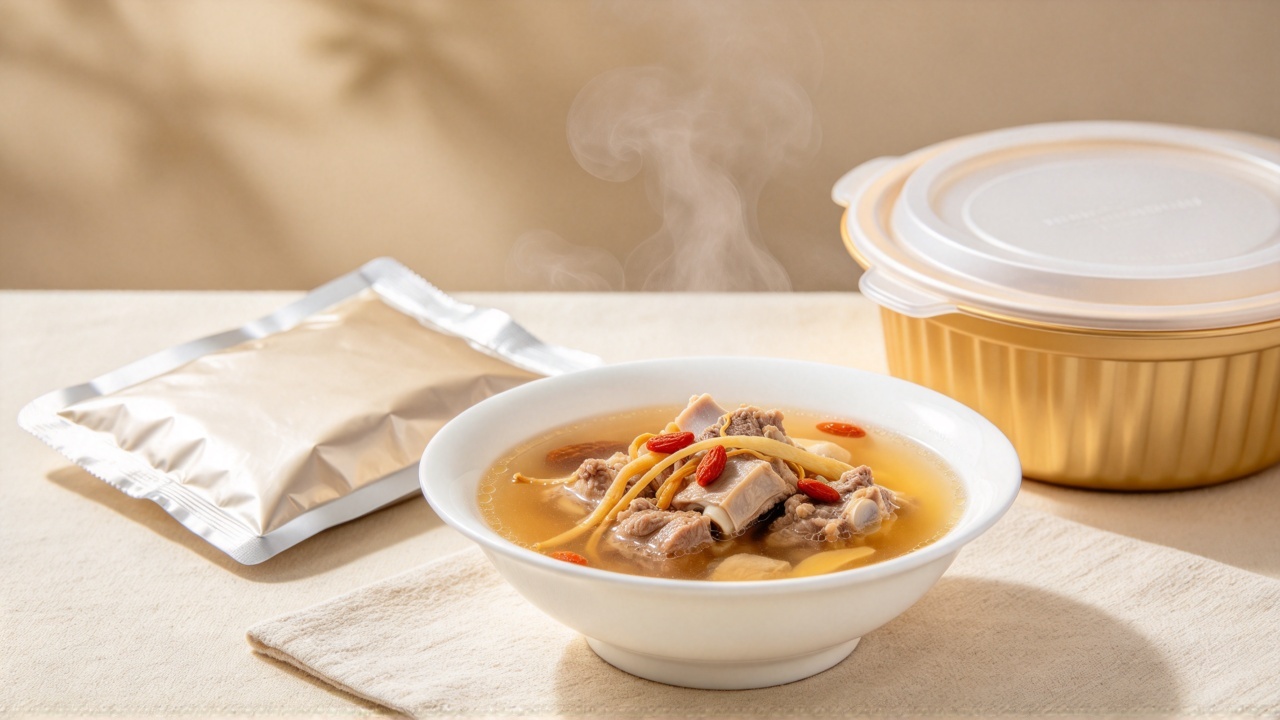
How Does Retort Pouch Soup Stay Shelf Stable Without Any Preservatives?
A retort pouch soup that sits at ambient temperature for months and still tastes like soup is not a formulation achievement. Nothing in the recipe is holding microbial growth back. What happened is that the food was sealed first and heated second, so the heat acted on a package that had already closed, and that closure survived the heat. Everything else, from ingredient grading to fill weight to cooling water quality, exists to protect that one idea. Here is the sequence in the order the plant runs it, and what each stage is actually defending against.
Intake and Pretreatment: The Contaminants a Retort Cannot Remove
Retorting kills microorganisms. It does not remove grit, it does not rescue a rancid lot, and it will not soften a fibrous piece that was too coarse going in. So the first stage is subtractive: take things out of the ingredient stream before they become a finished-product problem.
Incoming lots are checked against the agreed specification, covering moisture, color, foreign matter, and piece size for dried ingredients. Dried reishi and dendrobium arrive in slices of uneven thickness; pork bones arrive with attached tissue and marrow. Washing, sorting, and trimming follow, then size reduction to a target the filling line can dose accurately.
Piece size is not cosmetic. It sets how quickly heat reaches the center of a solid, and it sets how much solid fits inside a fixed fill weight. A batch with a wide size spread heats unevenly, and the pouch holding the largest piece is the one that decides whether the cycle was sufficient. Blanching bones before batching removes surface protein foam; left in place, that foam scorches onto the pouch wall during the retort and shows up later as a dark ring and a flat, over-boiled flavor.
A wide piece-size spread means the largest piece, not the average, sets the sterilization cycle. Grading ingredients before batching is cheaper than extending the cycle for every pouch in the load.
Batching and Blend Consistency Before the Pouch Closes
Batching fixes the ratio of solids to liquid, the seasoning, and the viscosity. All three travel with the pouch into the vessel, and all three change how the contents heat.
Viscosity is the variable buyers underestimate. A thin broth moves by convection, so heat distributes through the pouch. A thick, starch-bound soup moves mainly by conduction, which is slower, and the cold point sits somewhere else entirely. That is why a recipe adjustment, more starch or a heavier collagen-rich stock or larger solids, can require fresh heat penetration work even when nothing about the vessel changed.
The batching record is also the traceability spine. It ties every ingredient lot number to the finished lot code, which is what keeps a recall scoped to specific production rather than to everything in the warehouse.
Where the formula comes from changes what this stage looks like. Under retort pouch soup OEM manufacturing the batching sheet is a transcription of a customer-supplied recipe, and tolerances are argued out at sampling. Under retort pouch soup ODM development the recipe is still moving here, and batching is where a bench sample becomes something a line can repeat on a Tuesday.
Filling: Headspace, Fill Weight, and a Clean Seam
Filling doses solids and liquid into the pouch and leaves a measured volume of headspace above the product. Both numbers matter more than they look.
Headspace becomes a gas pocket during processing. Too little and the expanding contents press against the seam from the inside. Too much and the top of the pouch becomes an insulating pocket, so product near the seal heats more slowly and the declared fill weight drops. Headspace is set against the pouch format, the product temperature at fill, and the overpressure the vessel will apply.
The second job at this station is keeping the seal area clean. Soup that splashes onto the inner film before sealing leaves a film of oil or starch exactly where the two surfaces need to bond. Fill speed, nozzle design, a short settle time before the jaws close, and periodic wipe checks are the levers that keep that area clean.
An oil or starch film in the seal area creates a channel that survives the retort and only shows up as a swollen pouch weeks later. It is prevented at the filler, not caught at inspection.
Retort Pouch Sterilization: Where Retort Pouch Soup Shelf Stability Comes From
Retort pouch sterilization is the stage that makes the shelf life claim true. A sealed pouch enters a pressure vessel, saturated steam or a steam-air mixture raises the contents above the boiling point of water, and the load is held long enough to reduce the target organisms to a defined level.
Three parameters matter together, and only two of them do the killing. Retort temperature and time set the lethality delivered to the cold point, the slowest-heating location in the pouch, which is located by measurement for each product and format rather than assumed from a drawing. Pressure does a mechanical job: it holds back the expanding headspace so the pouch does not balloon, stretch the seam, or press the contents hard against the film. A schedule with the correct temperature and the wrong overpressure produces a sterile but deformed pouch.
What sits inside decides the schedule. A low-acid product such as reishi and dendrobium pork bone soup needs a full pressure retort. An acidic product can often be handled by hot fill, where the product is dosed hot and held so the heat does the same work without a vessel. Hot fill vs retort sterilization comes down to pH and to whether the solids will carry heat reliably to the center. This is also why a preservative free soup can sit at ambient: nothing in the recipe is suppressing growth. The process removed what would have grown.
Only temperature and time reduce the microbial load. Overpressure exists to protect the seam and the pouch geometry while that reduction happens, so the two are validated separately.
Cooling: The Half of the Cycle That Spoils Product
Cooling gets less attention than sterilization and causes more spoilage. The pouch has to come down out of the range where thermophilic organisms multiply, and it has to come down while the vessel is still under pressure. Release the external pressure first and the internal pressure has nowhere to go: the film balloons, the seam is pulled outward, and a marginal seal becomes an open one.
Cooling water is the second risk. It contacts the pouch surface at the moment the pouch is under the most mechanical stress, and any micro-leak in the seam becomes a route inward. Water quality is therefore handled as an ingredient-grade control, with microbial load and recirculation monitored, not as a utility.
Rate matters for quality as well. Cooling too fast wrinkles the film and puts a permanent set in the seal area that shows at retail. Cooling too slowly leaves the load sitting in a warm band long enough for surviving spores to germinate. The window is set per format and per fill weight.
Pouch Seal Integrity: Formed Before the Retort, Verified After
A flexible pouch format only works if the seam is stronger than the forces placed on it. The seam is heat-sealed before the pouch ever reaches the vessel, and three settings control it. Temperature melts the sealant layer. Dwell time lets the polymer flow and diffuse across the interface. Pressure keeps the two surfaces in contact while that happens. Too cold and fusion is incomplete, which leaves a channel. Too hot and sealant is squeezed out of the joint, leaving a thin brittle seam that passes a visual check and splits during handling.
Verification happens after cooling. Operators inspect seams for wrinkles, folds, and trapped product. A water-bath vacuum test submerges a sample, pulls a vacuum, and watches for a continuous stream of bubbles from a pinhole; when the vacuum releases, water drawn back into the pouch confirms the leak. Destructive peel tests on the same interval measure bond strength rather than the presence of a hole.
Bubble testing finds holes. It does not find a seam that held through the retort and will split when a consumer opens the pouch, which is why peel strength runs on the same schedule.
Outer Packaging: Pouch, Carton, and the Self-Heating Base
A retort pouch packaging system has two layers doing different jobs. The pouch is the sterile barrier: it went through the vessel and it holds the shelf life. The outer container carries the pouch, the utensil, and, in the self-heating version, the heating component seated in the base.
That component never enters the retort and never contacts the food. The pouch is processed on its own and placed into the container during secondary packing. To heat the soup, the consumer rotates the bottom of the container to activate the base, and the reaction inside the base warms the pouch. No external water, no power, no flame.
For private label retort pouch soup, this is the stage where a project becomes a specific product: printed film, carton artwork, lot code, and the match between them. Film and carton are proofed against the same approved sample at the same time, because a correctly printed pouch packed into a carton printed from an older file is a retail problem no process control downstream can fix. Case packing and secondary materials do not change the shelf life of the pouch, but they do change the damage rate between the plant and the shelf.
Release Testing and Shelf Life: What the Lot Has to Prove
Release testing follows an in-house protocol agreed at sampling and typically covers sensory evaluation, physicochemical checks, microbiological testing as required for the product and stage, and a seal check on the finished pouch. The lot does not ship on the strength of the process records alone; the two have to agree.
Shelf life is established on two tracks. Real-time storage holds samples at ambient conditions and pulls them at intervals. Accelerated storage holds samples at elevated temperature to compress the calendar. The second track gives an early read, but it does not map linearly for every attribute: texture softening, color drift, and seal strength age at different rates, and components migrating into the sealant over months can change a seam that tested well at release. Retort pouch soup shelf life testing therefore uses the accelerated result to plan and the real-time result to confirm, and the assigned shelf life is tied to a specific recipe, pouch format, and fill weight rather than to the category.
A reference point for how these stages stack up in a finished product: the reishi dendrobium pork bone soup in foil pouch carries a shelf life that was assigned to that recipe and that pouch, not to soup in general.
Frequently Asked Questions About Self-Heating Soup
Is shelf stable soup without preservatives actually stable, or just well sealed?
Both conditions are required and neither is sufficient alone. The retort delivers enough heat to the cold point to inactivate what is inside the sealed pouch, and the seam then keeps new organisms out for the life of the product. A perfect seal over unprocessed soup will spoil. A fully processed lot in a leaking pouch will also spoil. Shelf stability sits on the pair.
How is retort pouch soup shelf life testing carried out?
Two tracks run in parallel. Real-time samples are held at ambient and pulled at set intervals for sensory, microbiological, and seal checks. Accelerated samples are held at elevated temperature to reach the same checkpoints sooner. Accelerated results guide planning but are not substituted for real-time confirmation, because texture, color, and seal strength do not age at the same rate. The assigned shelf life applies to the recipe and format that were tested.
Does the self-heating container go through the retort?
No. Only the pouch is processed. The heating component sits in the base of the outer container, is never retorted, and never contacts the food. The pouch is packed into the container after processing, and the consumer rotates the bottom of the container to activate the base at the point of use.
Why does a recipe change require the process to be re-validated?
Because the cold point moves. Adding starch or collagen changes the product from convecting to conducting, larger solids lengthen the path heat must travel, and a different fill weight changes the geometry inside the pouch. Any of those can leave the previous schedule short at the new cold point, so heat penetration is re-measured rather than assumed to carry over.
No stage in this sequence compensates for another. A precise retort cannot recover a seam that was sealed through an oil film, and a flawless seam cannot recover a load that was cooled too slowly. Preservative-free shelf stability is the sum of eight ordinary controls, each of which is boring on its own and decisive in combination.
Develop Your Own Self-Heating Soup Product
Du développement des recettes et du traitement en autoclave à l'emballage et à la documentation prête pour l'exportation, ZeaGrove accompagne le développement de vos produits en vous fournissant des informations sur les processus que vous pouvez vérifier par rapport à vos propres spécifications.
 English
 Chinese
 French
 Italian
 Russian
 Arabic
 Indonesian
 Vietnamese
 Thai
 Spanish